More Than Meets The Mogwai

Saturday, May 03, 2008

ULZANA'S RAID (Aldrich, 1972) European Cut / Burt Lancaster's edit - Extended/Alternate/Deleted Scenes

Bless the user on youtube who took the time to upload these extended/alternate/deleted scenes of Robert Aldrich's most monumental work inside the western genre. They stem from a long, gone OOP UK VHS release.

Here, they're presented in chronological order of the film's events:


Labels: , ,

Thursday, December 27, 2007

Recent Viewings: THE CHOIRBOYS; SUPERMAN III; VENUS

THE CHOIRBOYS (Robert Aldrich, 1977) USA
A strange, offensive, excoriating portrait of the L.A. police department at large; makes buffoons out of novelist Joseph Wambaugh’s tortured protagonists, previously celebrated in the equally as-impressive THE NEW CENTURIONS (but for different reasons). The episodic narrative perhaps takes some getting used to, as my viewing companions couldn’t really get into the rhyme or rhythms of leaving one set of characters for extended periods of time. I think it’s brilliant.
==============================================================
SUPERMAN III (Richard Lester, 1983) UK
Lester pokes holes in the mythology of a hero he helped to establish with SUPERMAN II. Not content to make a conventional superhero movie, Lester starts the proceedings with an extended gag-filled accident overload in the streets of Metropolis, foretelling the similar scenes later in the film when Superman comes into contact with a tampered bit of Kryptonite, and is rendered otherwise useless to all myopic, self-destructive humans (and who begin to argue with one another because of raging oil prices.) The closing battle with the “supercomputer” is negligible, and so is the casting of Richard Pryor, but the duality of man fight (inside a junkyard!) between Clark Kent and his Super Alter ego is a keeper; at first, it’s the scruffy incarnation of Superman lashing out as his clumsy, benevolent self, but it erupts into a free-for-all with decency emerging on top.
There’s a sly reference to A HARD DAY’S NIGHT (and HELP!) byway of a rocking early Beatles song at the high school reunion. Extras on the Special Edition DVD include 19 minutes of extended scenes and useless comedy bits involving Pryor, and an hour-long making-of with far too few glimpses of Lester calling the shots.
==============================================================

VENUS (Roger Michell, 2006) UK
Michell’s use of a ragged Peter O’Toole here is not unlike the Mark Romanek-directed video for Johnny Cash’s “Hurt”, for both projects rely on seasoned wrinkles and the past cultural iconography of each subject – while curiously shaking away any embarrassing episodes in their respective careers in order for it to seem that O’Toole only did Shakespeare and Cash only produced murder ballads (as for O’Toole, here I’m speaking of his campaign for last year’s Best Actor, which rightly or wrongly beckoned viewers and voters to realize the esteem they should hold for the British thespian; this arguably culminated [thankfully] in the reissue of BECKET.) It’s a rewriting and a whitewashing of history so that my generation can easily enjoy decades old idols, making them more palatable and therefore emblematic of some lofty simpleminded conceit.
Michell shoots most of the film as conventionally as possible, but will grow self-conscious halfway through a dialog scene and end up on an oblique or awkward angle. He’s striving for a rough-hewn approximation of Mike Leigh realism, and he achieves it mostly by the presence of O’Toole, who is seemingly always in the throes of aged agony and because he essentially is the respectable, decaying actor he’s portraying.
Early on, O’Toole brings the brash young niece (Jodie Whittaker) of his best friend (Leslie Phillips) home from a night of drinking, and crashes into the porch area of the homestead; Michell then time-cuts to O’Toole in a hospital bed, family at his side, while everyone cries out at his just-expired body – but somebody yells cut, and we realize we’ve been had, and that VENUS will have very little interior wisdom, save for the saving grace of O’Toole's tired frame, wiry grey hair, booming Shakespearean voice, and admirable overabundance of talent. It’s miracle enough that he’s still with us.

Labels: , , , , ,

Monday, July 16, 2007

Lee Marvin and google video

On Theatre, Henry Hathaway, Raoul Walsh, Fritz Lang, VIOLENT SATURDAY and SEVEN MEN FROM NOW:


On Robert Aldrich:


On Early Television, "M Squad", John Brown, Ida Lupino, and DELTA FORCE:


On Don Siegel, CAT BALLOU, THE PROFESSIONALS, JOHN BOORMAN:


On MONTE WALSH, Sam Fuller:


On LIBERTY VALANCE and John Ford:


On Menahem Golan:

Labels: , , , ,

Thursday, May 24, 2007

Image(s) and Quote(s) of the Day: Robert Aldrich and VERA CRUZ (1954)


“VERA CRUZ was total improvisation because the script was always finished about five minutes before we shot it, and we’d sit right down and work it out and then shoot it as we went along. I’m not sure that that’s the right way to work. It’s easier, perhaps, on a western or a big, sprawling, physical picture. But not on a small and tense personal picture. I think you get much more range of character if you know the whole thing before you start and you sit down and examine it and build it layer by layer rather than discover three-quarters of the way through the picture that he’s not that kind of feller at all.”

“On VERA CRUZ you did it as well as you could, and then you got it and shot it, and then you’d move on.”

--director Robert Aldrich, interviewed by Ian Cameron and Mark Shivas, Movie 8 (April, 1963)

“I’m sixty-three and I’ve had hits every ten years and I just hope I can function long enough to have one in the ‘90s.”

--Aldrich to Roderick Mann, “Los Angeles Times Calendar”, 11 October 1981

Both interviews reprinted in “Robert Aldrich: Interviews”, editors: Eugene L. Miller, Jr. and Edwin T. Arnold (2004: University Press of Mississippi)

VERA CRUZ recently (re)released as part of the Gary Cooper: MGM Movie Legends Collection, along with the silent THE WINNING OF BARBARA WORTH (Henry King, 1926), THE COWBOY AND THE LADY (H.C. Potter, 1938, with a story credit by Leo McCarey), and THE REAL GLORY (Henry Hathaway, 1939).

Labels: , , ,

Friday, March 03, 2006

"Sissy's Roles" (1977) - Robert Altman Meets "Saturday Night Live"


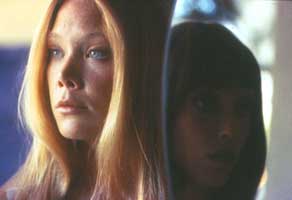
Without the proper context, a partial list of hosts of “Saturday Night Live” in its sophomore year could almost deceive someone into thinking that there’s some long lost Robert Altman opus out there. Such distinctive Altman regulars as Karen Black (Nashville), Shelley Duvall (very nearly every film of his 1970s output), Elliot Gould (M*A*S*H; The Long Goodbye; California Split), Sissy Spacek (3 Women), and Lily Tomlin (Nashville; Short Cuts; the upcoming A Prairie Home Companion) all took turns presiding over the show during its 1976-1977 season. Altman only contributed to the Spacek episode, but in this short film he gave audiences an invigorating, if ephemeral, glimpse into his then upcoming 3 Women by combining footage from that work with snippets of Alan Rudolph’s Welcome to L.A., a production he helped to get made for his former assistant director.

First airing on March 12, 1977, the episode also contained another pre-filmed short subject, directed by Gary Weis, in which a baton-twirling Sissy Spacek pantomimed to David Bowie’s “Fame”. But in the last half hour, Spacek introduced a “home movie” by Robert Altman, and set the stage for a truly avant-garde work that was heretofore unprecedented in his oeuvre. This television oddity also marked the first time he worked in the medium since before M*A*S*H, his breakthrough counterculture hit from 1970.

Heard on the soundtrack in the opening scene – which un-squeezes the 2.35:1 anamorphic dimensions of 3 Women, considerably narrowing the frame, and making it all too easy to demarcate which footage is which -- one can hear the voice of Altman as he calls out before the clapper during the scene in which Shelley Duvall and Spacek converse over vanilla milkshakes: “Here she goes…Action!”. A country jingle faintly strikes up, which will continue throughout the two minute and eighteen second short. Comprised of twenty-one shots, Altman hints at the “identity theft” at play between Duvall and Spacek in 3 Women during this most unconventional trailer. Spacek introduces herself to off-camera persons -- first as Ann Goode (Sally Kellerman’s character in Welcome to L.A.), then Linda (her real name in that film), Pinky (“but my real name is Mildred…” from 3 Women), and finally, Virginia (in Rudolph’s picture) – resulting in a contradictory concoction of filmic scraps that rejects any attempt at narrative coherence.

Next, Altman plays a game of call and answer with the editing. Spacek picks up a telephone receiver in one shot, and then responds to herself in a different voice in a different room from the different picture. This action is repeated once again, during which Altman underlines the difference in Spacek’s reaction, before using a moment in Rudolph’s film in which Keith Carradine deadpanns over whether Spacek can use his phone. This seemingly incongruous series of recurring actions and reactions continues on for the final minute with Duvall telling Spacek that she can share her closet contrasted with a similar moment from Welcome to L.A. Altman finishes off the piece with several revealing shots of Spacek in various stages of undress, with the indelible image of Spacek slinging her panties over a wire hanger -- before cutting to her washing dishes and meekly humming a country tune.

Altman’s exercise in montage subtly connects both films in a myriad of ways, with the least common factor being the use of the same actors and actresses. There’s a similar sensibility in the devotion given to actress Spacek in both Rudolph and Altman’s films that makes the interconnectedness seem organic. And while I don’t mean to inflate this brief work with more importance than there should be, I do think that the film works on three concurrent levels: 1. a tribute to his recent actress’s range and capabilities; 2. a nonconformist’s attempt at splicing together two films for his own unique version of coming attractions; and 3. a repetitive, discordant mix of the thematic concerns Altman was focusing on at the time of post-production on his most feverish dreamscape on celluloid -- 3 Women.

Labels: